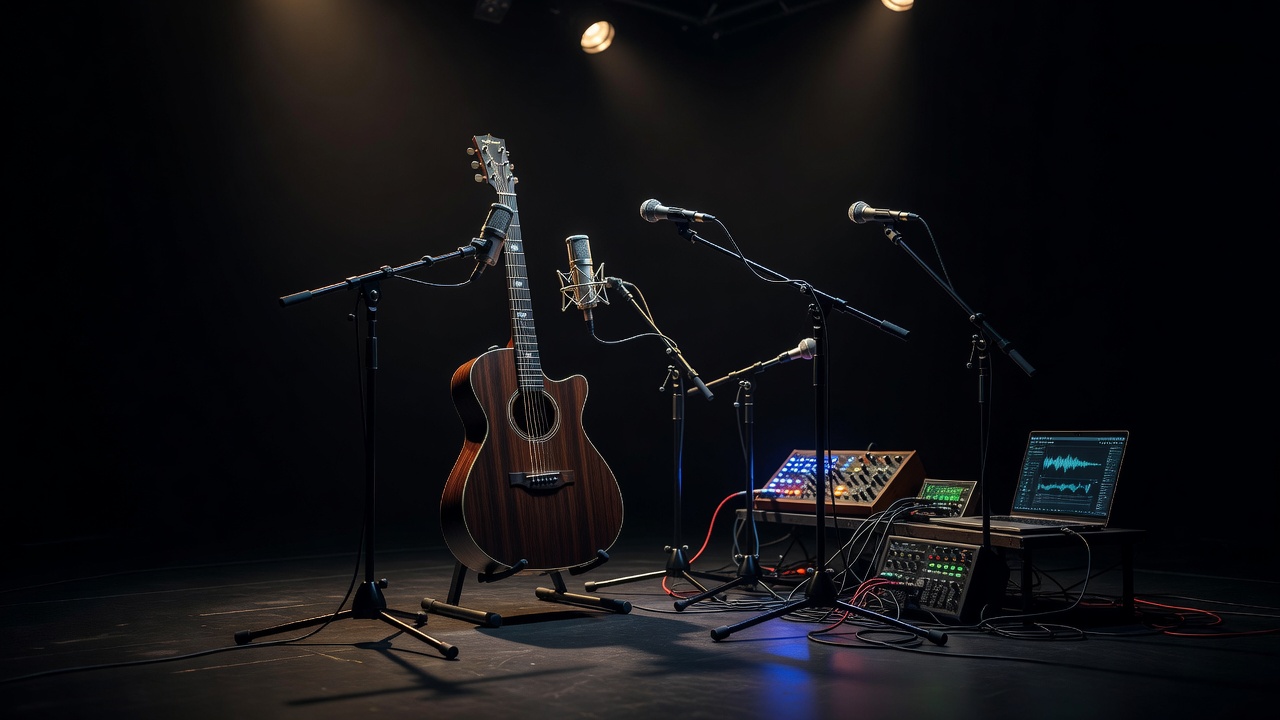
Start with the arrangement, not the label
“Fusion” can describe an encounter, a marketing category or a listener's uncertainty. It rarely tells us which musical principles are changing. An arrangement might preserve a melodic vocabulary while replacing its rhythmic setting. Another might keep an instrument but abandon its customary role. A third may grow from long-term collaboration so thoroughly that naming two separate source traditions becomes misleading.
Listen first for function. Is the instrument carrying a composed theme, improvising over a repeating pattern, marking time or producing texture? Then ask how the other parts respond. A sampled pluck decorating an otherwise unchanged track is a different relationship from a composition whose tuning, pacing and structure have been reshaped around the player.
Jambinai: the instrument changes its job
The Korean group Jambinai brings instruments including geomungo, haegeum and piri into an ensemble also using rock instrumentation. The result is not simply a conventional rock band with a brief “traditional” solo. Low attacks, abrasive sustained lines and dense collective builds can place those instruments at the center of the sound's architecture.
Try following one instrument through a quiet passage and into a full-band section. Does it remain a foreground melody, become a rhythmic engine or merge into a mass of sound? This is a useful way to hear continuity without demanding that every phrase demonstrate an older repertoire. The musicians' knowledge can inform the work even where the surface resists an easy genre label.
Instrumental vocabulary
Attack, ornament, pitch inflection and the physical behavior of strings or reeds supply possibilities learned through practice.
Changed relationships
Amplification, distortion and ensemble density can move those possibilities into different structural roles.
Anoushka Shankar: a practice across projects
Anoushka Shankar's work includes Hindustani performance and collaborative projects across musical settings. Her album Traveller explores encounters involving sitar and flamenco musicians, while Land of Gold works within a different collaborative and thematic frame. These projects should not be collapsed into one generic recipe for combining “East” and “West.” The named participants and the actual arrangements matter.
In a sitar-led collaboration, hear what happens to the space around a bending note. A sustained accompaniment may support one kind of phrasing; a sharply accented groove may invite another. Do not assume that a shared pulse means two traditions have identical rhythmic concepts. The tension or negotiation between different approaches can be precisely what gives a performance its interest.
Arooj Aftab: poetry, space and listening expectations
Pakistani-born, New York-based Arooj Aftab draws listeners toward a spacious sound world in which voice, poetry and carefully placed instrumental parts carry unusual weight. Her album Vulture Prince is a useful invitation to question how quickly we assign music to a single category. Urdu poetry and South Asian musical references do not prevent an arrangement from opening toward other contemporary practices.
Listen to the duration of a vocal line and the silence after it. Notice whether accompaniment answers, sustains or simply leaves room. An unhurried texture is not automatically ambient music, and an Urdu text does not automatically make a performance qawwali. Categories can guide research, but they should not substitute for hearing what a recording actually does.
Technology is a musical decision
A microphone emphasizes some details and minimizes others. Compression can extend perceived sustain; looping can turn a single gesture into an environment. Electronic processing is therefore not merely a modern layer laid over an untouched acoustic source. It can change the performer's timing, articulation and relationship with the room.
At the same time, novelty is not a measure of quality. A musician working within a well-established format can make profound interpretive choices, while an elaborate cross-genre production may remain musically thin. Compare how convincing the relationships sound rather than awarding points for the number of traditions named in a press release.
Credit the exchange
Look for performer names, composition credits, source texts and sample acknowledgments. When a recording draws on ceremonial or community-held material, availability online does not by itself establish permission for reuse. Respectful listening includes noticing who is named, who holds decision-making power and whether a tradition is described precisely enough for listeners to find its practitioners.
Choose two recordings by the same artist before deciding what their work represents. Musicians have careers, experiments and changes of mind; they are not permanent symbols of a meeting between two cultures. The most useful listening habit is to keep an ear on the specific decision happening now.
Artist-led starting points
- Jambinai on Bandcamp — releases and credits published through the artist's presence.
- Anoushka Shankar's official website — projects and artist context.
- Arooj Aftab's official website — current artist information.